
Table of Contents
I was only partially persuaded that I had chosen a bad career when I began my internship at a digital marketing business six months ago. AI is coming for marketing jobs, according to every other headline.
Friends kept asking, only half-joking, “Will that job even exist in two years?”
Six months in, I have a different answer. Digital marketing isn’t disappearing because of AI — it’s splitting into two groups: people who use AI as leverage, and people who get outpaced by the ones who do. I’ve watched both playbooks play out from an intern’s desk, mistakes included, and I want to walk you through exactly what that looks like.

What AI Actually Does on My Desk Every Day
I use three AI tools daily: ChatGPT for image generation, Canva for visual assets, and Claude for copywriting drafts and ideation. None of them has replaced my job. What they’ve replaced is the worst part of it — the blank page and the hours spent manually compiling competitor notes.
Here’s the honest breakdown of how a typical task changed once I started using AI tools for marketing work:
| Task | Before AI | With AI |
| First draft of ad copy | 45–60 minutes staring at a blank doc | 5 minutes to generate 3–5 rough options |
| Competitor research | 1–2 hours manually browsing sites | 20 minutes gathering + verifying data |
| Visual assets | Waiting on a designer or template hunting | Canva drafts in minutes |
| Final, client-ready copy | Same as above, minus editing time | Still done by me, by hand |
AI shortens the “getting started” stage, according to a predictable pattern. It doesn’t touch strategy, tone, or final judgment — that part is still entirely mine.
The Time AI Saved 60% of My Prep Time — and Where It Fell Short
The clearest example from my six months was a cold outreach email campaign for a local business promotion. I needed several email variations fast, so I used AI to generate a batch of drafts as a starting point.
It worked, and it didn’t. The speed was real: what would normally take hours of staring at a blank screen took minutes to get a working structure. But the tone was off. The text produced by AI had a forceful tone and relied on clichés that were inconsistent with the client’s true brand voice. The script read like a hype-filled SaaS startup, but a local, relationship-driven company doesn’t sound like one.
I therefore updated the messaging by hand using softer language, particular local allusions, and a tone that reflected the client’s actual customer interactions while maintaining the framework. I was still able to save about 60% of my typical prep time while maintaining the necessary level of quality even after that revision. The true value is a quicker beginning point that still requires a human editor with client context, rather than a final result.
The Time AI Almost Put a Fake Statistic in Front of a Client
Not every AI story on my team has a clean ending. A teammate used AI to pull industry benchmark statistics for a client presentation. The numbers looked credible, formatted cleanly, sitting right there in the slide deck. Right before the meeting, someone caught it: one of the cited statistics was completely hallucinated. It didn’t exist in any real source.
We scrambled to swap in verified data before the client walked in. Nothing went wrong publicly — but it easily could have. If that number had made it into the room, it would have cost real credibility with the client, and possibly the account.
This is the part of the “AI takeover” conversation that gets skipped a lot: AI is confident even when it’s wrong. An unconfirmed statistic is a major mistake in digital marketing, because customer trust is the foundation of the company strategy. Every time AI interacts with data, fact-checking must take place.
My Framework: Where AI Ends and Judgment Begins in Digital Marketing
After six months, I default to a simple split for every task:
- AI handles: first drafts, brainstorming variations, competitor data gathering, rough visual concepts, repetitive formatting
- I handle: brand voice, client-specific tone, strategy, fact-checking, final performance tracking decisions
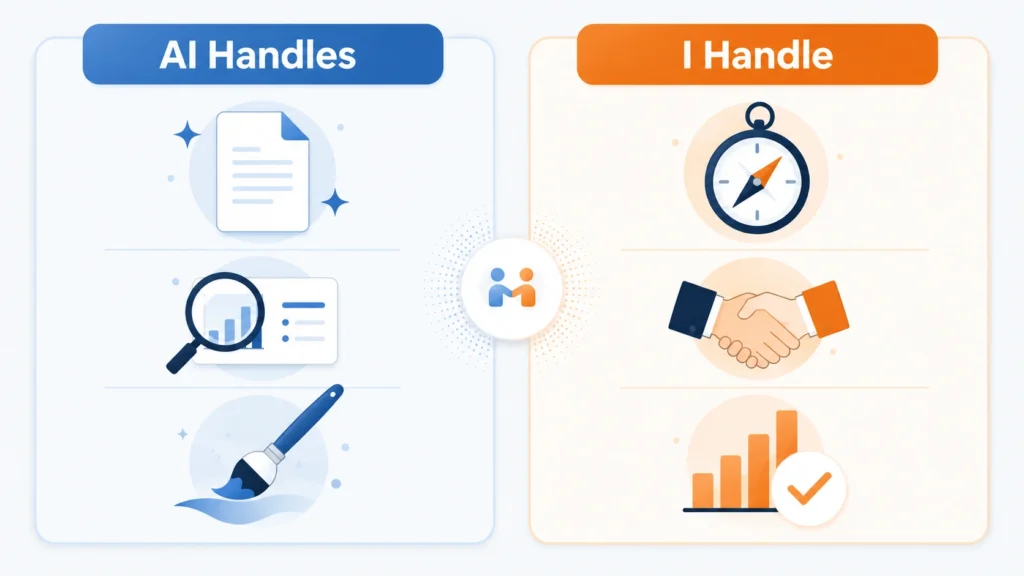
This isn’t a rule I read somewhere — it’s the line I’ve drawn after watching AI succeed and fail in real client work. When I stick to it, projects move faster without losing quality. When I skip the human review step to save time, that’s exactly when mistakes like the hallucinated stat happen.
Typical Errors Marketers Make When Using AI
A few patterns show up again and again, even among people more experienced than me:
- Publishing AI’s first draft as final copy — skipping the brand-voice pass entirely.
- Trusting AI-generated statistics without a second source — the exact mistake that nearly hit our client presentation.
- Using AI for strategy, not just execution — AI can suggest a campaign angle, but it doesn’t know your client’s history, past failures, or audience nuance.
- Treating every AI tool the same — ChatGPT, Canva, and Claude are genuinely good at different things, and using the wrong one for a task wastes more time than it saves.
So, Will AI Replace Digital Marketers?
Based on what I’ve seen, no — but the ground is shifting fast, and pretending otherwise isn’t honest. 63% of marketers presently use generative AI, according to a Salesforce’s marketing study, indicating that adoption is already the standard expectation for the industry and is no longer a future trend. Teams in digital marketing that have not implemented any AI workflow are becoming the exception rather than the rule.
That does not imply that the position is eliminated.
That doesn’t mean the job disappears. It means the job changes shape. AI won’t replace digital marketers, but digital marketers who use AI well will replace the ones who don’t. That’s not a scare tactic — it’s just what I’ve watched happen with my own team over six months. The people getting more responsibility aren’t the ones avoiding AI or the ones blindly trusting it. They’re the ones who know exactly when to use it and when to override it.
One honest limitation here: I’m speaking from an agency-intern seat, working mostly on small business and local campaigns. Enterprise marketing teams with bigger budgets, legal review layers, and more complex compliance needs may lean on AI differently than we do — worth keeping in mind before applying this framework one-to-one to a much larger organization.
How to Future-Proof Your Digital Marketing Career
Here’s what I’m actually doing with my own six-month runway if you’re just getting started in digital marketing:
- Create a workflow that prioritizes AI rather than just AI. Let AI take care of the first 80% of the work—drafts, research, and variations—and use the time you save to focus on the final 20%—judgment, tone, and strategy.
- Practice intentionally identifying poor AI output. Get a statistic or a claim from AI, then go check it out for yourself. That habit alone would have caught our hallucinated statistic before it reached a slide.
- Learn your client’s or company’s voice cold. AI can mimic a tone once you describe it well — but you have to actually know the difference between “on-brand” and “generic” first.
- Track what AI saves you, and reinvest the time. I saved 60% of my prep time on one campaign. That time went into refining messaging, not into finishing early — that’s the trade that actually builds skill.
FAQs
Will AI take over digital marketing jobs completely? Based on current adoption data and hands-on experience, no. AI is replacing specific tasks — first drafts, data gathering, repetitive research — not full roles. Judgment, brand voice, and client relationships still require a person.
What AI tools are actually used by interns in digital marketing? In my opinion, a useful starter stack consists of Claude for copywriting drafts and outlines, Canva for visual assets, and ChatGPT for image production and ideation. The task at hand determines the ideal combination rather than a single “best” tool.
Can I rely on data produced by AI in a report on digital marketing? Not without verification. AI can generate confident-sounding but false statistics, as happened with a benchmark stat on my own team before a client meeting. Before presenting numbers to a client, always double-check them against an authentic, named source.
Because of AI, is it too late to begin a career in digital marketing? No. Adoption data shows most marketers are already using AI daily, which means the skill gap isn’t about whether you use AI — it’s about how well you use it. Starting now with an AI-first mindset is still a real advantage.
Conclusion: The Real Takeaway After 6 Months
AI hasn’t taken over digital marketing — it’s taken over the parts of the job that were never really the job. The blank page, the manual research, the first rough draft: that’s execution work, and AI is genuinely good at it. What’s left is strategy, brand judgment, client trust, and catching the mistakes AI doesn’t know it’s making. That’s the actual work now, and it’s more interesting, not less.